
Read Surah An Nas Online سورۃ الناس – The Final Surah | Arabic Text, Urdu Translation, Transliteration & Tafseer
Surah An Nas (سورۃ الناس) is the 114th and final chapter of the Holy Quran. The last Surah in the divine revelation. It consists of 6 verses (ayat), 20 words, and 80 letters. Its name “An Nas” (الناس) means “The Mankind” or “The People” in Arabic. Surah An Nas is one of the two Mu’awwidhatayn (المعوذتين) the two protective Surahs — alongside Surah Al Falaq (113th chapter). It was revealed in Makkah, making it a Makki Surah, though some scholars classify it as Madani. Surah An Nas teaches believers to seek refuge in Allah as the Lord (Rabb), King (Malik), and God (Allah) of all mankind — from the whispers (waswas) of Shaytaan, who sneaks into human hearts and retreats the moment Allah is remembered. It is the Quranic seal: the divine revelation ends with a call for Allah’s protection, reminding every believer that the greatest battle is not external — it is the internal war against the whispering enemy within.
Surah An Nas (سورۃ الناس) PDF
Surah An Nas Overview
| Suratun Nas Ayats | Surah Naas Words | Surat Nas Letter | Surah An Naas Ruku |
| 6 | 20 | 80 | 1 |
Listen Surah An Nas Online
Colour Coded Tajweed Rules

Surah An Nas Read Online
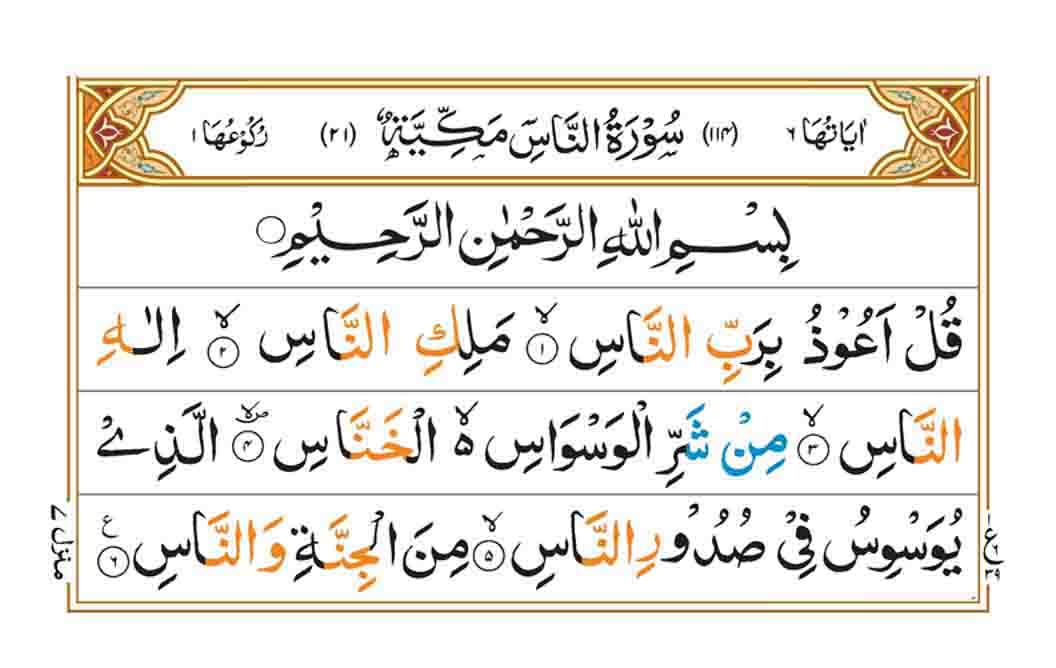
Surah An Nas Transliteration | Full Roman English
Bismillaahir Rahmaanir Raheem
Verse 1:
Qul a’oodhu bi-rabbin naas
Verse 2:
Malikin naas
Verse 3:
Ilaahin naas
Verse 4:
Min sharril waswaasil khannaas
Verse 5:
Alladhee yuwaswisu fee sudoorin naas
Verse 6:
Minal jinnati wan naas
Surah An Nas English Translation — Verse by Verse
In the name of Allah, the Most Gracious, the Most Merciful
Verse 1:
“Say: I seek refuge in the Lord of mankind”
Verse 2:
“The King of mankind”
Verse 3:
“The God of mankind”
Verse 4:
“From the evil of the sneaking whisperer”
Verse 5:
“Who whispers in the hearts of mankind”
Verse 6:
“From among the jinn and mankind”
سورۃ الناس اردو ترجمہ — آیت بہ آیت
بسم اللہ الرحمٰن الرحیم
آیت 1:
“کہہ دیجیے: میں پناہ مانگتا ہوں لوگوں کے رب کی”
آیت 2:
“لوگوں کے بادشاہ کی”
آیت 3:
“لوگوں کے معبود کی”
آیت 4:
“وسوسہ ڈالنے والے چھپ جانے والے کے شر سے”
آیت 5:
“جو لوگوں کے سینوں میں وسوسہ ڈالتا ہے”
آیت 6:
“جنوں میں سے بھی اور انسانوں میں سے بھی”
Surah An Nas | Complete Tafseer, Background & Verse-by-Verse Explanation
When Was Surah An Nas Revealed? (Asbab al-Nuzul)
Surah An Nas is a Makki Surah according to the majority of scholars — revealed in the early years of Prophet Muhammad’s ﷺ mission in Makkah. However, some scholars including Ibn Abbas (RA) classify it as Madani. There is a narration that both Surah An Nas and Surah Al Falaq were revealed together as a ruqya (spiritual healing) when a Jewish man named Labid ibn al-Asam performed sihr (magic/witchcraft) on the Prophet ﷺ. Angel Jibreel (AS) descended with both Surahs as a cure and protection. The revelation order of Surah An Nas is the 21st Surah revealed — making it one of the earliest revelations despite being the final chapter in the Quran’s arrangement.
The Three Names of Allah in Surah An Nas — A Profound Spiritual Structure
Allah describes Himself using three majestic attributes in verses 1–3, building a complete foundation for seeking His protection:
Rabb al-Nas (Lord of Mankind): Allah is the Sustainer, Nourisher, and Guardian of all people. As our Rabb, He has full authority over us and it is most fitting to seek refuge with Him.
Malik al-Nas (King of Mankind): Allah is the absolute Sovereign over all of humanity. No king, no power, no force in the universe can protect except the One who holds ultimate sovereignty.
Ilah al-Nas (God of Mankind): Allah is the only true deity worthy of worship. By invoking this Name, the believer affirms Tawheed — the Oneness of Allah — as the foundation of all protection.
Scholars of Tafseer note that by invoking all three attributes together, the believer is seeking protection at every level: physical (Rabb), political/societal (Malik), and spiritual/divine (Ilah). This is the most comprehensive du’a for protection in the Quran.
Who is Al-Waswas Al-Khannas? (Verse 4–5 Explained)
The enemy described in verse 4 is given two names: Al-Waswas (الوسواس) — “the Whisperer” — describes his method: he communicates in silent, barely-audible suggestions directly into the human heart. Al-Khannas (الخناس) — “the Retreater” — describes his strategy: he perches on the human heart and whispers when a person is heedless of Allah, but immediately retreats and slinks away the moment the person remembers Allah (makes dhikr). This is the profound teaching of verse 4–5: the single most powerful weapon against Shaytaan’s whispers is the remembrance of Allah — SubhanAllah, Alhamdulillah, Allahu Akbar, La ilaha illAllah.
Verse 6 — Whispers from Jinn AND Humans
Verse 6 reveals something profound: the whispering enemy is not only from the Jinn (unseen creation) but also from humans. This means people around us — whether intentionally or through their speech, their pessimism, their doubts, their negativity — can whisper evil into our hearts just as Shaytaan does. Surah An Nas protects against both categories of whispers simultaneously.
How the Prophet ﷺ Used Surah An Nas
Aisha (RA) narrated: “When the Prophet ﷺ went to bed every night, he would cup his hands together, blow into them, and recite Surah Al Ikhlas, Surah Al Falaq, and Surah An Nas. He would then wipe whatever he could of his body, starting with his head, face, and the front of his body. He would do this three times.” (Sahih Bukhari 5017) This is the Sunnah — the three Surahs together (called Al-Mu’awwidhatayn plus Al-Ikhlas) are the bedtime protection taught by the Prophet ﷺ himself.
5 Key Lessons from Surah An Nas for Every Muslim
The internal battle is greater than the external battle
Surah Al Falaq (the preceding Surah) protects against external harms — black magic, envious people, physical dangers. Surah An Nas protects against internal harm — the whispers that corrupt the heart from within. By placing An Nas last, Allah teaches us that the greatest battlefield is not the world outside — it is the fortress of your own heart.
Dhikr (remembrance of Allah) is your most powerful weapon
Al-Khannas means “he who retreats.” Shaytaan retreats the moment you remember Allah. This is both a warning and a solution: every time you feel doubt, negative thoughts, temptation, or spiritual heaviness — say “AudhuBillahi min ash-shaytanir rajeem” and make dhikr. Shaytaan physically withdraws from a heart filled with Allah’s remembrance.
Allah is your Lord, King AND God — three layers of protection
By invoking Allah as Rabb (Sustainer), Malik (King), and Ilah (Deity) — you are placing yourself under three layers of divine protection simultaneously. As your Rabb, He nourishes you. As your Malik, He governs all affairs. As your Ilah, He alone deserves your worship and trust.
Evil whispers come from humans too, not only Shaytaan
Verse 6 explicitly mentions “from among the jinn AND mankind.” This teaches us to be mindful of human influences on our hearts. People who spread doubt about Islam, who encourage haram, who plant seeds of envy or despair. Seek Allah’s protection from all sources of waswas, not just the unseen enemy.
The Quran ends with a prayer — not a statement
It is profoundly significant that the entire Quran — 114 Surahs of divine guidance — concludes with a du’a for protection. This teaches that no matter how much knowledge and guidance a person acquires, they must always remain in a state of seeking Allah’s help and protection. The greatest scholars never stop making du’a.