
Read Surah Al Nasr Online سورۃ النصر – The Last Surah Revealed | Arabic Text, Urdu Translation & Tafseer
Surah Al Nasr (سورۃ النصر) is the 110th chapter of the Holy Quran, consisting of only 3 verses (ayat) and 19 words. It is a Madani Surah — revealed in Madinah after Hijrah — and is widely considered the last complete Surah revealed to Prophet Muhammad ﷺ before his passing. The word “Al Nasr” (النصر) means “The Help” or “The Victory” in Arabic. This blessed Surah foretells the victory of Islam through the Conquest of Makkah, the mass acceptance of Islam by the Arab tribes, and instructs the Prophet ﷺ — and all believers — to respond to every success with Tasbih (glorification), Hamd (praise), and Istighfar (seeking forgiveness). It is the Surah of Divine Help, Completion, and Gratitude.
Download Surah Al Nasr PDF
Surah Al Nasr Overview
| Surah An Nasr Ayats | Surah Al Nasr Words | Surah Nasr Letter | Suratul Nasr Ruku |
| 3 | 19 | 77 | 1 |
Listen Surah Al Nasr Online
Colour Coded Tajweed Rules

Read Surah Al Nasr Online
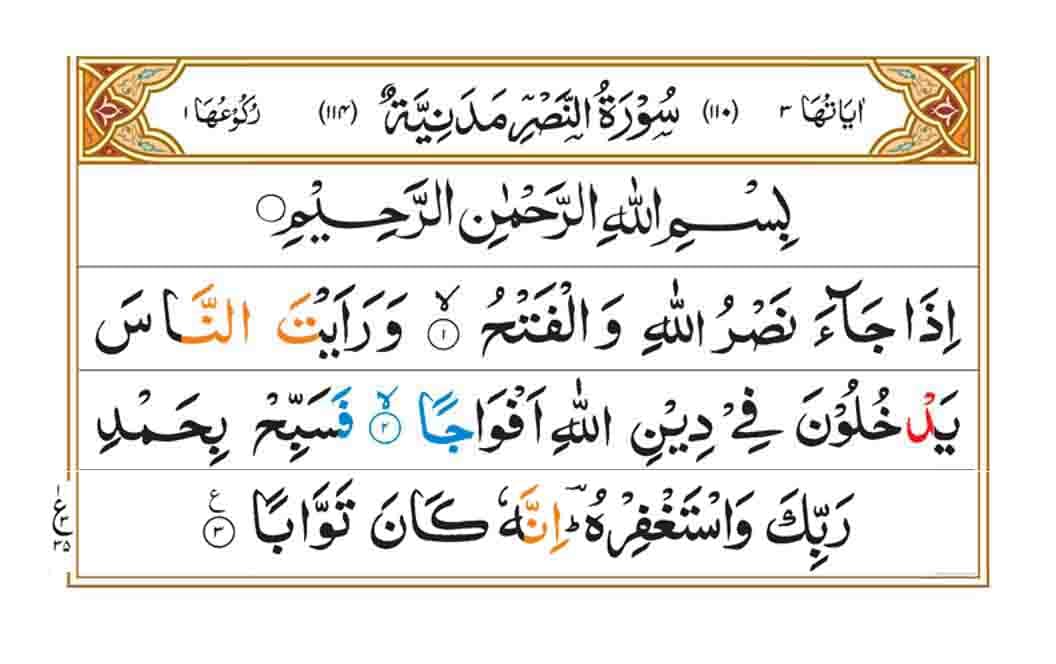
Surah Al Nasr Transliteration — Full Roman English
Bismillaahir Rahmaanir Raheem
Verse 1:
Idhaa jaa’a nasrullaahi wal-fath
Verse 2:
Wa ra’aitan-naasa yadkhuloona fee deenil-laahi afwaajaa
Verse 3:
Fasabbih bihamdi rabbika wastaghfirh, innahoo kaana tawwaabaa
Surah Al Nasr English Translation — Verse by Verse
In the name of Allah, the Most Gracious, the Most Merciful
Verse 1:
“When the victory of Allah has come and the conquest”
Verse 2:
“And you see the people entering into the religion of Allah in multitudes”
Verse 3:
“Then exalt [Him] with praise of your Lord and ask forgiveness of Him. Indeed, He is ever Accepting of repentance.”
سورۃ النصر اردو ترجمہ — آیت بہ آیت
بسم اللہ الرحمٰن الرحیم
آیت 1:
“جب اللہ کی مدد اور فتح آ جائے”
آیت 2:
“اور تم دیکھو کہ لوگ اللہ کے دین میں فوج در فوج داخل ہو رہے ہیں”
آیت 3:
“تو اپنے رب کی حمد کے ساتھ تسبیح کرو اور اس سے مغفرت مانگو، بیشک وہ بہت توبہ قبول کرنے والا ہے”
Surah Al Nasr — Background, Revelation & Tafseer
When Was Surah Al Nasr Revealed?
Surah Al Nasr is a Madani Surah, revealed in the 10th year of Hijrah — the final year of the Prophet’s ﷺ life on Earth. Scholars of Tafseer, including Ibn Kathir, agree that it is the last complete Surah of the Quran to be revealed. It was revealed during the Farewell Pilgrimage (Hajj al-Wida) or shortly after the Conquest of Makkah in the 8th year of Hijrah.
Historical Context — The Conquest of Makkah
After 23 years of prophethood, the Prophet Muhammad ﷺ entered Makkah victoriously in Ramadan 8AH. The idols of the Kaaba were destroyed and the city that had persecuted the early Muslims was now the heart of the Islamic world. The Arab tribes who had been watching from the sidelines now entered Islam in huge numbers — “in multitudes” as this Surah describes. With this, the mission that had begun in a cave on Mount Hira was complete.
What Does Each Verse Mean?
Verse 1 “When the victory of Allah has come and the conquest”: This refers to the Conquest of Makkah (Fath al-Makkah). “Nasr” (help) is from Allah. “Fath” (opening/conquest) refers to the opening of Makkah to Islam.
Verse 2 “And you see the people entering into the religion of Allah in multitudes”: After Makkah’s conquest, the remaining Arab tribes abandoned their resistance and embraced Islam. This fulfilled Allah’s promise of spreading Islam across the Arabian Peninsula.
Verse 3 “Then glorify with praise of your Lord and seek His forgiveness”: Instead of celebrating the victory with pride, Allah commands His Prophet ﷺ to respond with three actions: Tasbih (say SubhanAllah — glorify Allah), Hamd (say Alhamdulillah — praise Allah), and Istighfar (say AstaghfirAllah — seek forgiveness). This was also a subtle sign to the Prophet ﷺ that his mission was complete and his return to Allah was near.
The Response of the Prophet ﷺ
After this Surah was revealed, Aisha (RA) narrated: “The Messenger of Allah ﷺ used to frequently say: SubhanaAllahi wa bihamdihi, AstaghfirullahA wa atubu ilayh (Glory be to Allah and His is the praise, I seek forgiveness of Allah and I repent to Him).” (Bukhari, Muslim) This shows how the Prophet ﷺ responded to the command of Allah immediately and consistently.
5 Key Lessons from Surah Al Nasr for Every Muslim
- Respond to every success with gratitude and humility
Allah did not command the Prophet ﷺ to celebrate the Conquest of Makkah with pride. Instead He commanded praise, glorification, and seeking forgiveness. The lesson for every believer: whenever you achieve anything — a promotion, a marriage, a child, a business success — your first response must be “Alhamdulillah” and “AstaghfirAllah”, not self-congratulation. - Every victory comes from Allah alone — not from your effort
The Surah opens: “When the VICTORY OF ALLAH has come.” The victory is attributed to Allah, not to the Muslims’ military strength or strategy. No matter how hard we work, the result belongs to Allah. This destroys arrogance and builds tawakkul (reliance on Allah). - Istighfar (seeking forgiveness) should increase in times of success
Most people turn to Allah during hardship and forget Him during ease. The Surah reverses this — it commands MORE ibadah, MORE dhikr, and MORE istighfar precisely at the moment of greatest worldly success. The Prophet ﷺ embodied this by increasing his dhikr after this revelation. - Even the most righteous must seek forgiveness
The Prophet ﷺ — who was sinless (masoom) — was commanded to seek forgiveness. This is not because he had sinned, but to teach his Ummah that istighfar is not only for sinners. It is an act of worship, an acknowledgment of Allah’s greatness, and a recognition of our own human limitation. - The completion of a great task signals a new beginning, not an ending
This Surah signalled that the Prophet’s ﷺ mission on Earth was complete. But his response was not to rest — it was to increase in worship and preparation to meet his Lord. For Muslims, the completion of any great task — Ramadan, Hajj, raising children — should signal deeper reflection and increased ibadah.