
Introduction & Revelation Context of Surah Al Infitar
Surah Al Infitar (Suratul Infitar), meaning “The Cleaving,” is a profoundly powerful chapter revealed in the early Meccan period of Prophet Muhammad’s (PBUH) mission. This context is vital to understanding its intense and awe-inspiring message. During this time, the fledgling Muslim community faced severe persecution and mockery, particularly regarding the concept of the Hereafter. The polytheists of Mecca found the idea of bodily resurrection absurd and impossible.
Surahtul Infitar was revealed as a direct response to this disbelief, serving as a divine rebuttal that uses the most dramatic imagery from the universe itself to prove Allah’s absolute power to recreate and hold humanity to account. Its primary purpose is to shatter human complacency and awaken the soul to the undeniable realities of a Creator, the Day of Judgment, and the ultimate consequence of every single deed. The Surah’s concise yet vivid style is designed to leave an indelible mark on the heart, forcing a moment of sincere self-reflection.
Surah Al Infitar Overview
| Surah Al Infitar Ayats | Surah Al Infitar Words | Surah Al Infitar Letter | Surah Al Infitar Ruku |
| 19 | 81 | 333 | 1 |
Listen Surah Al Infitar Online
Colour Coded Tajweed Rules

Read Surah Al Infitar Online
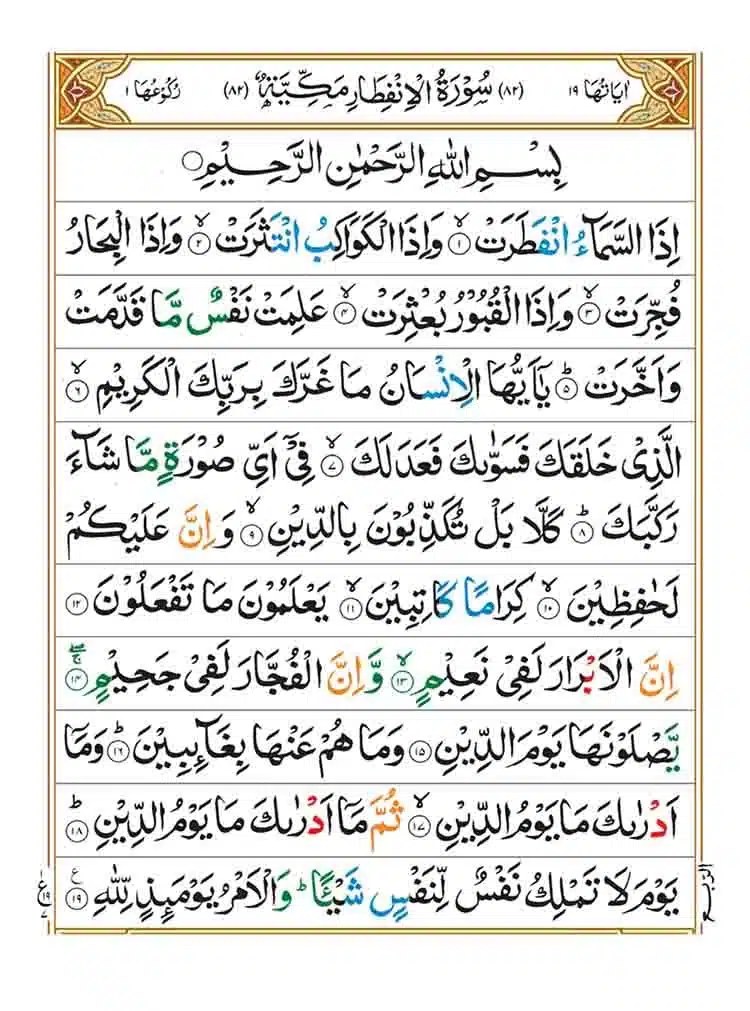
Detailed Tafsir: Verse-by-Verse Explanation
Verses 1-3: The Cosmic Collapse
The Surah opens with a breathtaking sequence of cosmic catastrophes. “When the sky is cleft asunder” describes the heavens being torn apart, rupturing the very fabric of the universe we consider permanent. This is followed by “When the stars fall, scattering,” depicting the celestial bodies we see as fixed and majestic losing all order and raining down in chaos. Finally, “When the seas are erupted” portrays the vast oceans, symbols of immense depth and power, overflowing and merging as their boundaries are destroyed. This trilogy of upheaval—affecting the sky, the stars, and the seas—is a powerful testament to the complete reversal of the natural order on a day when Allah’s command manifests in its entirety.
Verses 4-5: The Personal Reckoning
The scene then shifts dramatically from the universal to the intensely personal. “When the graves are overturned” signifies not just the physical resurrection of the dead but the symbolic unveiling of everything that was hidden—secrets, intentions, and deeds. This act leads to the core moment of truth: “then a soul will know what it has put forth and kept back.” At this point, all illusions, excuses, and denials vanish. Every individual will instantly possess a complete and undeniable understanding of all the good they advanced and all the evil they neglected or committed, facing the ultimate consequence of their life’s choices.
Verses 6-8: The Piercing Question
Amidst this scene of universal and personal chaos, Allah poses a soul-shattering question: “O mankind, what has deceived you concerning your Lord, the Generous?” This question highlights the profound ingratitude and heedlessness of humanity. It asks what could possibly lead a person to disobey the very Lord who bestowed honor and grace upon them, who created them in the best form, and who perfectly proportioned them and granted them the faculties of hearing, sight, and intellect. The deception, the Surah implies, is a tragic folly of prioritizing fleeting worldly life over the Eternal Creator.
Verses 9-12: The Root Cause and Constant Witness
The Surah immediately answers its own question, identifying the root cause of human deception: “No! But you deny the Recompense.” The fundamental denial of accountability and the Day of Judgment is what makes a person act with such audacity. To eliminate any doubt about the feasibility of this accountability, the Surah reminds us of the ever-present recording angels: “And indeed, [appointed] over you are keepers, noble and recording.” These are not lowly spies but honorable scribes, the Kiraman Katibin, who meticulously record every deed, ensuring that the record presented on that Day is precise and complete.
Verses 13-16: The Inescapable Outcome
The Surah concludes with the ultimate, binary destiny of all humanity, leaving no room for a third option. “Indeed, the righteous will be in pleasure,” experiencing the everlasting bliss of Paradise (Jannah). In stark contrast, “Indeed, the wicked will be in Hellfire,” a fate of utter torment. The final verse, “They will not be absent from it,” delivers a chilling finality. On the Day of Judgment, the wicked will enter the Hellfire, and there will be no escape, no reprieve, and no second chance to return to the world they once took for granted.
Verses 17-19: The Ultimate Reality and Loss of Power
The Surah culminates by driving home the absolute inevitability and supreme authority of that Day. “And what can make you know what the Day of Recompense is?” This rhetorical question emphasizes that its true horror and nature are beyond human comprehension. It is then repeated with even greater force: “Again, what can make you know what the Day of Recompense is?” This repetition shakes the listener into paying utmost attention. The final, defining answer is given: “It is the Day when no soul will possess for another soul any power; and the command, that Day, is entirely with Allah.” This establishes the complete breakdown of all worldly systems of power, influence, and intercession. No wealth, no tribe, no family, and no leader can help another. On that Day, all authority belongs solely to Allah, the One True Judge, before whom every soul will stand alone and accountable.
Thematic Analysis: Core Messages of the Surah
Surah Al-Infitar, despite its brevity, is a dense and powerful chapter that conveys several core Islamic themes with immense clarity. Firstly, it establishes the Reality of the Hereafter (Akhirah) through its vivid imagery, making the Day of Judgment feel imminent and tangible. Secondly, it emphasizes the Absolute Power and Sovereignty of Allah (Rububiyyah), demonstrating that the One who created the heavens and seas can easily dismantle and recreate them.
A third, crucial theme is Individual Accountability; the shift from cosmic events to a single soul knowing its deeds underscores that each person is solely responsible for their actions. Furthermore, the Surah diagnoses the spiritual disease of Deception (Ghurur), questioning what leads humanity to forget its Creator. Finally, it establishes the foundation of Divine Justice, guaranteed by the recording angels and culminating in the fair and eternal destinations of Paradise and Hellfire.
Virtues, Benefits, and Practical Lessons for Today
Reciting and reflecting upon Surah Al-Infitar offers profound spiritual benefits and practical lessons for the modern believer. Its primary virtue lies in its power to instill Taqwa (God-consciousness), as its imagery serves as a constant reminder that we live under the watch of our Creator and will be held to account. It acts as a powerful cure for arrogance, humbling the soul by illustrating the fate of the mightiest creations like the sky and stars. For the believer, it serves as a potent motivation for good deeds and a deterrent from sin, making one mindful of the eternal consequences of their actions.
On a practical level, this Surah teaches us to live with purpose and intentionality, encouraging a regular self-audit to identify what “deceptions”—like wealth, status, or busyness—might be leading us astray in our daily lives. It is a call to cultivate gratitude for Allah’s countless favors, from our very creation to the intellect we possess, and to strengthen our prayers by standing before Him with the humility and awe that this Surah inspires.
Read More Surahs
Surah Yaseen | Surah Maryam | Surah Yusuf |
Surah Waqiah | Surah Kahf | Surah Rahman |
Surah Juma | Surah Muzammil | Surah Falaq |