
Surah Al Fatiha: The Greatest Chapter of the Quran – The Opening, The Prayer & The Cure
Surah Al Fatiha (سورۃ الفاتحہ), also known as Umm al-Kitab (Mother of the Book), is the first and most important chapter of the Holy Quran. With only 7 verses, it is the essence of the entire Quran and the foundation of every Muslim’s prayer. The Prophet Muhammad ﷺ called it “the greatest Surah” and said that no prayer is valid without it.
This short but immensely powerful Surah is recited in every unit (rak’ah) of Salah — making it the most frequently recited portion of the Quran in the world. It is a complete prayer, a cure for physical and spiritual ailments, protection from evil eye, and a direct conversation between the servant and Allah.
On this page of Faiz e Islam, you can read Surah Al-Fatiha with beautiful Arabic text, accurate English translation, Roman transliteration, colour-coded Tajweed rules, audio recitation, and a downloadable PDF. Whether you want to understand its deep meanings, learn its virtues, or use it as a spiritual treatment, this complete resource is designed to help you connect with the Mother of the Book like never before.
Surah Al Fatiha Overview
| Surah Fatiha Ayats | Surah Fatiha Words | Surah Fatiha Letter | Surah Fatiha Ruku | Place of Revelation | Surah Fatiha Juz |
| 7 | 27 | 122 | 1 | Makkah | 1 |
Listen Surah Fatiha Online
Read Surah Fatiha Online
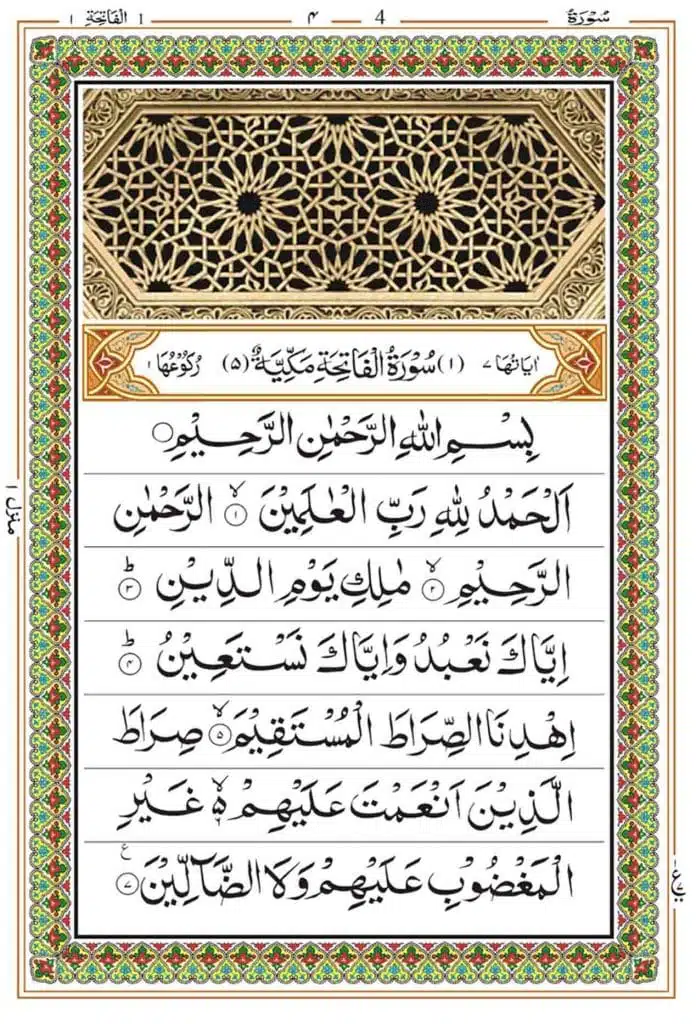
History and Background of Surah Al-Fatiha
Surah Al-Fatiha is the first chapter of the Holy Quran and holds a very special place in Islamic history. It was revealed in Makkah during the early days of Prophethood, most likely in the first or second year after the Prophet Muhammad ﷺ started receiving revelation.
According to many scholars, Surah Al-Fatiha was among the very first complete Surahs revealed to the Prophet ﷺ. Some narrations suggest it was revealed twice — once in Makkah as the foundation of the Quran, and later its status was reaffirmed in Madinah when the full system of Salah was established. It is one of the earliest revelations that taught the Muslims how to pray and how to communicate with Allah.
The historical context of its revelation was a time when the Prophet ﷺ and the small group of early Muslims were facing intense opposition and persecution from the Quraysh in Makkah. At that critical moment, Allah revealed this short but powerful Surah as a complete prayer and a source of strength. It gave the believers a beautiful way to praise their Lord and ask for guidance in the midst of darkness and trials.
The companions of the Prophet ﷺ loved Surah Al-Fatiha deeply. They understood that it was not just any chapter — it was Umm al-Kitab (Mother of the Book). The Prophet ﷺ himself gave it the highest status, saying:
“By the One in Whose Hand is my soul! Neither in the Torah, nor the Gospel, nor the Psalms, nor in the Quran has anything like it been revealed.” (Tirmidhi)
When the five daily prayers were made obligatory, Surah Al-Fatiha became an essential part of every Salah. The Prophet ﷺ taught his companions to recite it in every rak’ah, making it the most frequently recited portion of the Quran in the world — billions of times every single day.
Surah Al-Fatiha was revealed as a mercy for the entire Ummah. It is a direct conversation between the servant and Allah. The first three verses are praise and glorification of Allah, while the last three verses are our heartfelt supplication for guidance. In the middle verse, Allah responds to His servant with love and mercy.
This Surah has remained unchanged for over 1400 years. It is the foundation of our faith, the heart of our prayer, and a powerful source of healing and guidance for every generation of Muslims.vely blessed Surah Al-Fatiha is. Whether we call it the Opening, the Mother of the Book, the Prayer, or the Cure, one reality remains: this small Surah carries the weight of the entire message of Islam. Reciting it with love, understanding, and sincerity is one of the greatest acts of worship a Muslim can perform daily.
Other Names of Surah Al Fatiha
Surah Al-Fatiha is blessed with several beautiful and meaningful names that reflect its supreme status in the Holy Quran. These names are not merely titles — they reveal the different dimensions of its greatness, its role in worship, and its spiritual benefits. The Prophet Muhammad ﷺ and the early scholars loved referring to this Surah by these special names, each highlighting a unique aspect of its excellence.
The most common and well-known name is Al-Fatiha, which means “The Opening”. It is called so because it opens the entire Holy Quran and serves as the gateway to understanding all divine revelation. Just as a key opens a treasure chest, Surah Al-Fatiha opens the endless mercy and guidance of Allah for the reader.
It is also famously known as Umm al-Kitab (Mother of the Book). This name signifies that Surah Al-Fatiha is the foundation and summary of the entire Quran. All the major themes — praise of Allah, His mercy, worship, guidance, and the straight path — are beautifully contained in these seven verses. Because of this, it is considered the root from which the rest of the Quran branches out.
Another very important name is As-Salah (The Prayer). Since Surah Al-Fatiha is recited in every single unit (rak’ah) of Salah, it has been given this honorable title. The Prophet ﷺ said that no prayer is valid without it. It forms the heart of our conversation with Allah during worship.
It is also called Ash-Shifa (The Cure) because of its powerful healing properties for physical, mental, and spiritual ailments. Many Muslims use it as a form of ruqyah (spiritual healing) for sickness, evil eye, anxiety, depression, and black magic.
Other beautiful names include Al-Hamd (The Praise), because the Surah begins with praising Allah, and Sab’ul Mathani (The Seven Often-Repeated Verses), referring to the fact that these seven verses are repeated in every rak’ah of prayer throughout the day. Some scholars also call it Al-Kanz (The Treasure), describing it as a priceless treasure of guidance, mercy, and blessings for those who recite and understand it with sincerity.
To help you understand these names more clearly, here is a summary table:
| Name of Surah | Meaning in English | Significance & Reason |
|---|---|---|
| Al-Fatiha | The Opening | Opens the Quran and serves as the gateway to divine guidance |
| Umm al-Kitab | Mother of the Book | Foundation and summary of the entire Quran |
| As-Salah | The Prayer | Essential part of every Salah; without it prayer is invalid |
| Ash-Shifa | The Cure | Powerful spiritual and physical healing |
| Al-Hamd | The Praise | Begins with the praise of Allah |
| Sab’ul Mathani | The Seven Often-Repeated Verses | Repeated in every rak’ah of prayer |
| Al-Kanz | The Treasure | A priceless treasure of guidance and blessings |
These multiple names show us how comprehensively blessed Surah Al-Fatiha is. Whether we call it the Opening, the Mother of the Book, the Prayer, or the Cure, one reality remains: this small Surah carries the weight of the entire message of Islam. Reciting it with love, understanding, and sincerity is one of the greatest acts of worship a Muslim can perform daily.
Surah Al Fatiha Full – Verse by Verse (Arabic, Transliteration & English Translation)
Surah Al-Fatiha consists of 7 verses. It is the opening chapter of the Holy Quran and is recited in every unit of Salah.
Verse 1 Arabic: بِسْمِ اللَّهِ الرَّحْمَٰنِ الرَّحِيمِ Transliteration: Bismillaahir Rahmaanir Raheem English Translation: In the name of Allah, the Most Gracious, the Most Merciful.
Verse 2 Arabic: الْحَمْدُ لِلَّهِ رَبِّ الْعَالَمِينَ Transliteration: Alhamdu lillaahi Rabbil ‘aalameen English Translation: All praise is due to Allah, Lord of all the worlds.
Verse 3 Arabic: الرَّحْمَٰنِ الرَّحِيمِ Transliteration: Ar-Rahmaanir Raheem English Translation: The Most Gracious, the Most Merciful.
Verse 4 Arabic: مَالِكِ يَوْمِ الدِّينِ Transliteration: Maaliki yawmiddeen English Translation: Master of the Day of Judgment.
Verse 5 Arabic: إِيَّاكَ نَعْبُدُ وَإِيَّاكَ نَسْتَعِينُ Transliteration: Iyyaaka na’budu wa iyyaaka nasta’een English Translation: It is You we worship and You we ask for help.
Verse 6 Arabic: اهْدِنَا الصِّرَاطَ الْمُسْتَقِيمَ Transliteration: Ihdinas siraatal mustaqeem English Translation: Guide us to the straight path.
Verse 7 Arabic: صِرَاطَ الَّذِينَ أَنْعَمْتَ عَلَيْهِمْ غَيْرِ الْمَغْضُوبِ عَلَيْهِمْ وَلَا الضَّالِّينَ Transliteration: Siraatal lazeena an’amta ‘alayhim ghayril maghdoobi ‘alayhim wa lad daalleen English Translation: The path of those upon whom You have bestowed favor, not of those who have evoked [Your] anger or of those who are astray.
Benefits and Virtues of Surah Al-Fatiha
Surah Al-Fatiha holds a unique and exalted position in the Holy Quran. It is not just the opening chapter — it is the essence of the entire Book, a complete prayer, a spiritual cure, and a direct conversation between the servant and his Lord. The Prophet Muhammad ﷺ described it as the greatest Surah and said that no prayer is complete without it. Because it is recited in every single unit of Salah, it is the most frequently recited portion of the Quran across the world.
The virtues of Surah Al-Fatiha are immense. It is called Umm al-Kitab (Mother of the Book) because it beautifully summarizes the core message of the entire Quran: praise of Allah, His mercy, guidance, and our dependence on Him. Reciting it with understanding and sincerity brings countless blessings in both this world and the Hereafter. Many scholars consider it a powerful means of healing, protection, and barakah.
One of its greatest benefits is that it serves as a complete dua. The first half praises Allah, while the second half is our heartfelt request for guidance. When a servant recites “Guide us to the straight path,” Allah responds with mercy and opens doors of guidance. It is also known as Ash-Shifa (The Cure). The Prophet ﷺ used it for physical and spiritual healing, and generations of Muslims have experienced its miraculous effects on sickness, anxiety, depression, evil eye, and black magic.
Furthermore, Surah Al-Fatiha brings barakah in rizq and protection from poverty when recited with full conviction. It strengthens faith, removes doubts, increases love for Allah, and protects the reciter from Satan’s whispers. Parents often recite it over their children for protection, intelligence, and good character. Many people recite it 7, 41, or 313 times for specific needs such as marriage, job success, or family harmony.
To help you understand its blessings at a glance, here is a summary table:
| Benefit / Virtue | Description | How to Practice |
|---|---|---|
| Spiritual Healing (Ash-Shifa) | Cure for physical, mental, and spiritual ailments | Recite 7 times over water or oil |
| Protection from Evil Eye & Magic | Strong defense against nazar and sihr | Recite with Ayat al-Kursi & Mu’awwidhatayn |
| Increase in Rizq & Barakah | Opens doors of halal provision and blessings | Recite 41 times after Fajr |
| Guidance & Clarity | Removes confusion and shows the straight path | Recite daily with reflection |
| Reward in Prayer | Essential part of Salah — reward multiplied | Recite in every rak’ah with khushu |
| Protection from Satan | Weakens waswas (whispers) and strengthens iman | Recite when feeling low or anxious |
| Family Peace & Children | Brings harmony and protection for family | Recite over children before sleep |
The beauty of Surah Al-Fatiha lies in its simplicity and depth. Whether you are a new Muslim learning to pray or a lifelong believer seeking closeness to Allah, this Surah has something special for everyone. Regular recitation with understanding can transform your heart, bring peace to your mind, and invite endless mercy from Allah.
Many people have shared beautiful experiences after making Surah Al-Fatiha a daily habit — from sudden relief from long-term illnesses to unexpected sources of halal income and improved family relationships. Its power is not in magic, but in the sincere connection it creates between you and your Creator.