Your Ultimate Pilgrimage Manual – The Only Guide You Will Ever Need
Hajj 2026 complete guide. The blessed days of Hajj are approaching. For Muslims worldwide, this sacred pilgrimage represents the ultimate act of devotion—a journey that every able believer dreams of undertaking at least once in their lifetime.
As the month of Dhul-Hijjah 1447 AH approaches, millions of hearts are turning toward Makkah. This comprehensive guide will walk you through every ritual, every supplication, and every critical detail you need to know for Hajj 2026—from the 8th to the 13th of Dhul-Hijjah.
Whether you are a first-time pilgrim or seeking deeper understanding, this guide covers everything: step-by-step rituals, authentic Quranic verses and hadith, specific guidance for women, rulings on menstruation, powerful duas, and mistakes to avoid.
When is Hajj 2026? Key Dates You Must Know (Full Schedule)
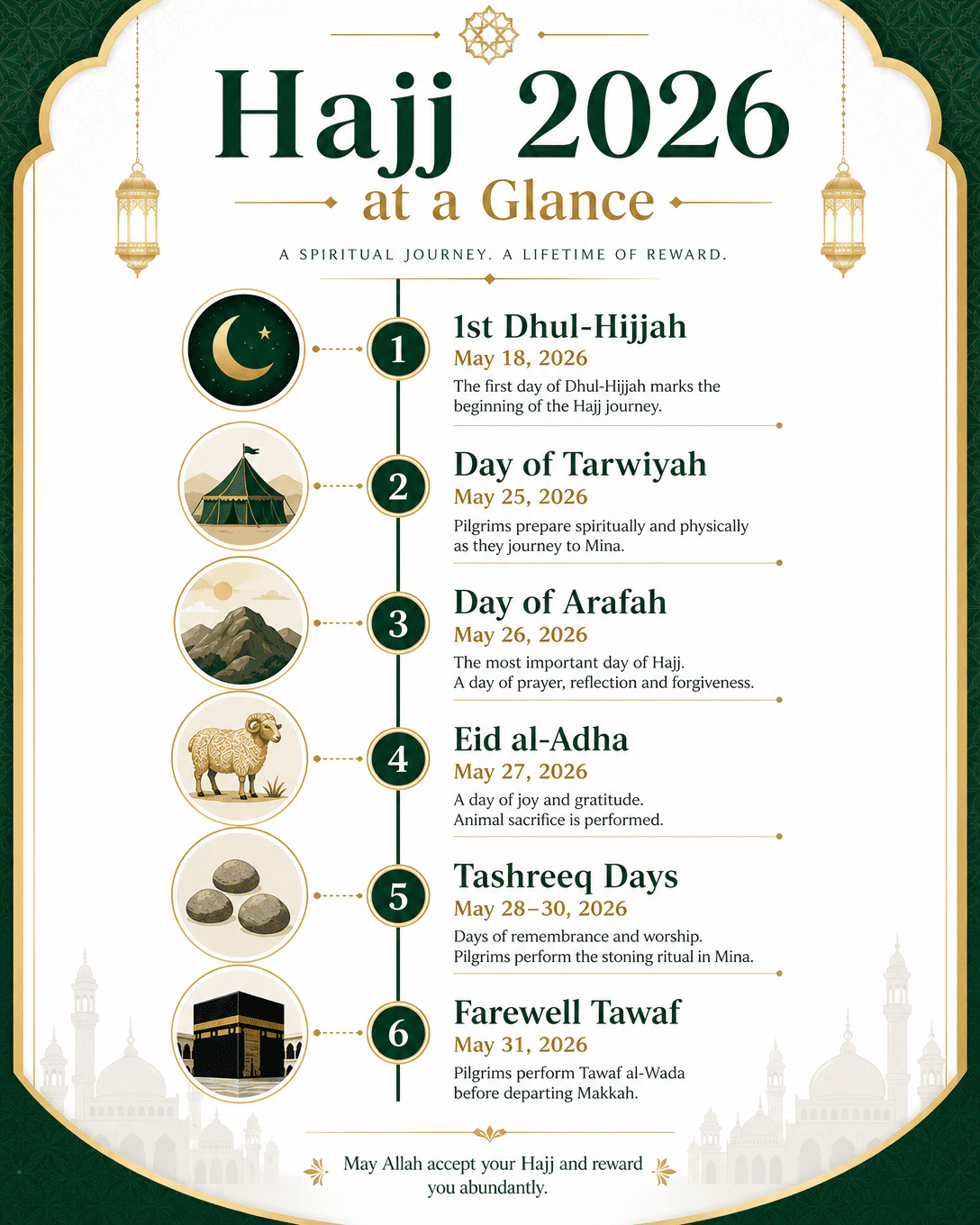
According to astronomical calculations, the central conjunction (new moon) for Dhul-Hijjah 1447 AH will occur on Saturday, May 16, 2026, at 11:01 PM Saudi time. The crescent moon sighting is expected on Sunday, May 17, 2026. The official announcement will be made by the Saudi Ministry of Hajj and Umrah.
Expected Hajj 2026 Dates (Astronomically Estimated)
| Event | Date (2026) | Day of Week | Significance |
|---|---|---|---|
| 1st Dhul-Hijjah begins | Monday, May 18 | Monday | Start of the blessed 10 days; voluntary fasting recommended |
| Day of Tarwiyah (8th Dhul-Hijjah) | Monday, May 25 | Monday | Enter Ihram for Hajj; depart to Mina |
| Day of Arafah (9th Dhul-Hijjah) | Tuesday, May 26 | Tuesday | The “Heart of Hajj” – standing at Arafah (wuquf) |
| Eid al-Adha / Nahr (10th Dhul-Hijjah) | Wednesday, May 27 | Wednesday | Stoning, sacrifice, shaving, Tawaf al-Ifadah |
| Days of Tashreeq (11th-13th Dhul-Hijjah) | May 28-30 | Thursday-Saturday | Stoning all three Jamarat; eat, drink, remember Allah |
| Farewell Tawaf (Tawaf al-Wida) | Before departure | Varies | Obligatory final circumambulation (exempt for menstruating women) |
⚠️ Important: These dates are astronomically estimated and subject to official moon sighting by religious authorities in Saudi Arabia and other Islamic countries. Always confirm with your local religious authorities or Hajj organizers.
Understanding the Three Types of Hajj (Choose Your Path)
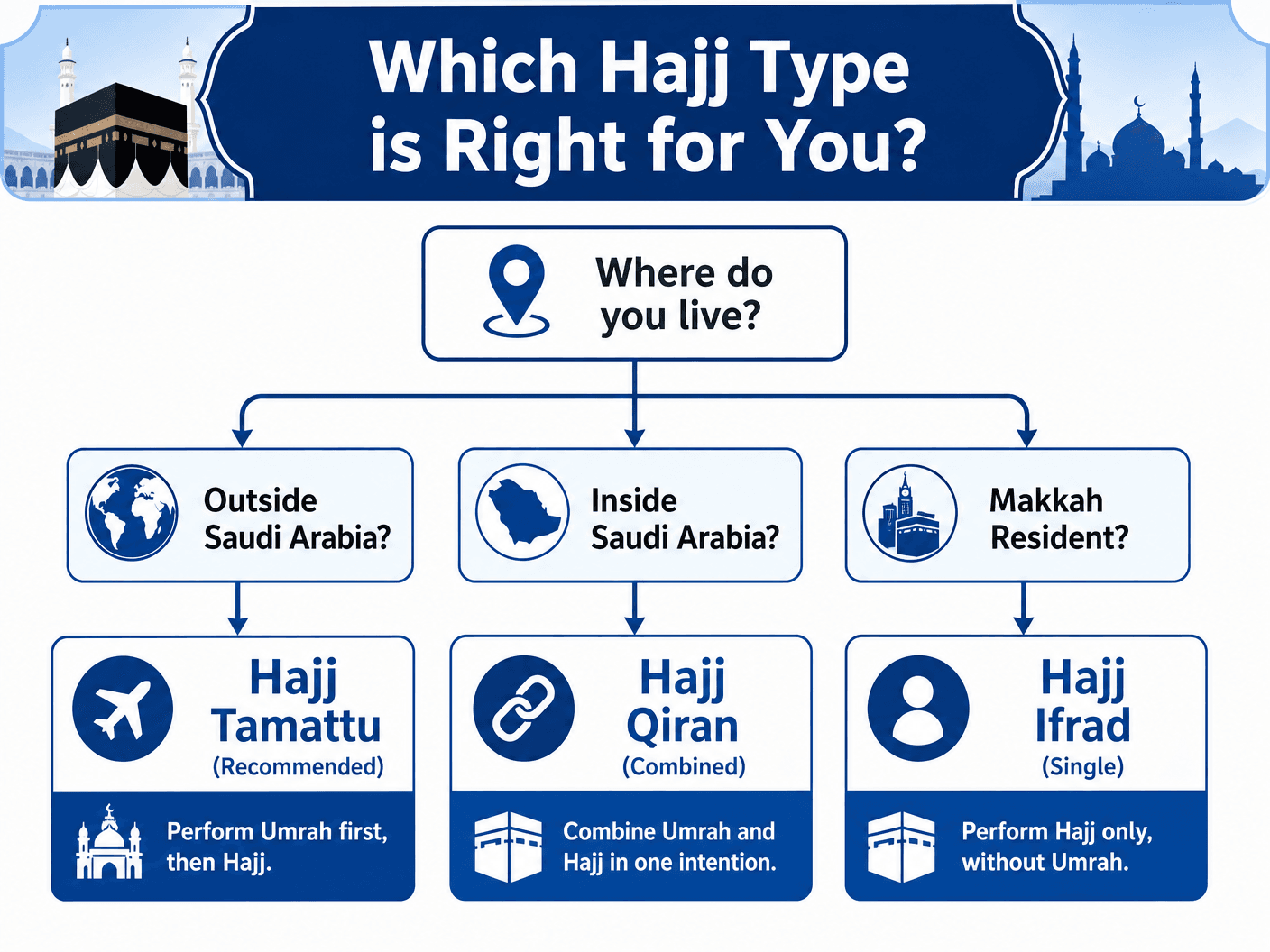
TABLE: Comparison of Hajj Types
| Type of Hajj | Ihram Entry | Umrah Performed Separately? | Exit Ihram Between Umrah & Hajj? | Sacrifice Required? | Best For |
|---|---|---|---|---|---|
| Hajj Tamattu’ (Most common) | Miqat (for Umrah first) | Yes, fully before 8th Dhul-Hijjah | Yes (then new ihram on 8th) | Yes (unless unable) | Overseas pilgrims; recommended by Prophet ﷺ |
| Hajj Qiran | Miqat (for both together) | Yes, combined with Hajj | No (one continuous ihram) | Yes | Those living near Makkah or arriving early |
| Hajj Ifrad | Miqat (for Hajj only) | No | Not applicable | No | Residents of Makkah or those in a hurry |
INFOGRAPHIC SUGGESTION: A flowchart titled “Which Hajj Type is Right for You?” Start with “Where do you live?” → “Outside Saudi?” → Tamattu’. “Inside Saudi or arriving early?” → Qiran. “Makkah resident or short time?” → Ifrad.
Before the Journey Begins – Preparing for Ihram (Sacred State)
What is Ihram?
Ihram is not just clothing—it is a sacred state in which certain normally lawful things become prohibited: using perfume, trimming hair, cutting nails, marital relations, hunting, and even quarreling. You can find the specific rulings on what is prohibited in Ihram in the Sahih al-Bukhari: Book of Hajj.
For men: Two white, unstitched sheets (izar around waist, rida over shoulders).
For women: Normal modest Islamic clothing (abaya, hijab, socks) – face and hands remain uncovered. No niqab or gloves.
How to Enter Ihram – Step by Step
- Perform ghusl (full bath) or wudu if water unavailable.
- Put on ihram garments (men).
- Pray two rak’ah nafl (optional, but highly recommended).
- Make clear intention (niyyah) in your heart: “O Allah, I intend to perform Hajj Tamattu’/Qiran/Ifrad.”
- Recite the Talbiyah aloud (men) or softly (women).
The Talbiyah – The Pilgrim’s Constant Refrain
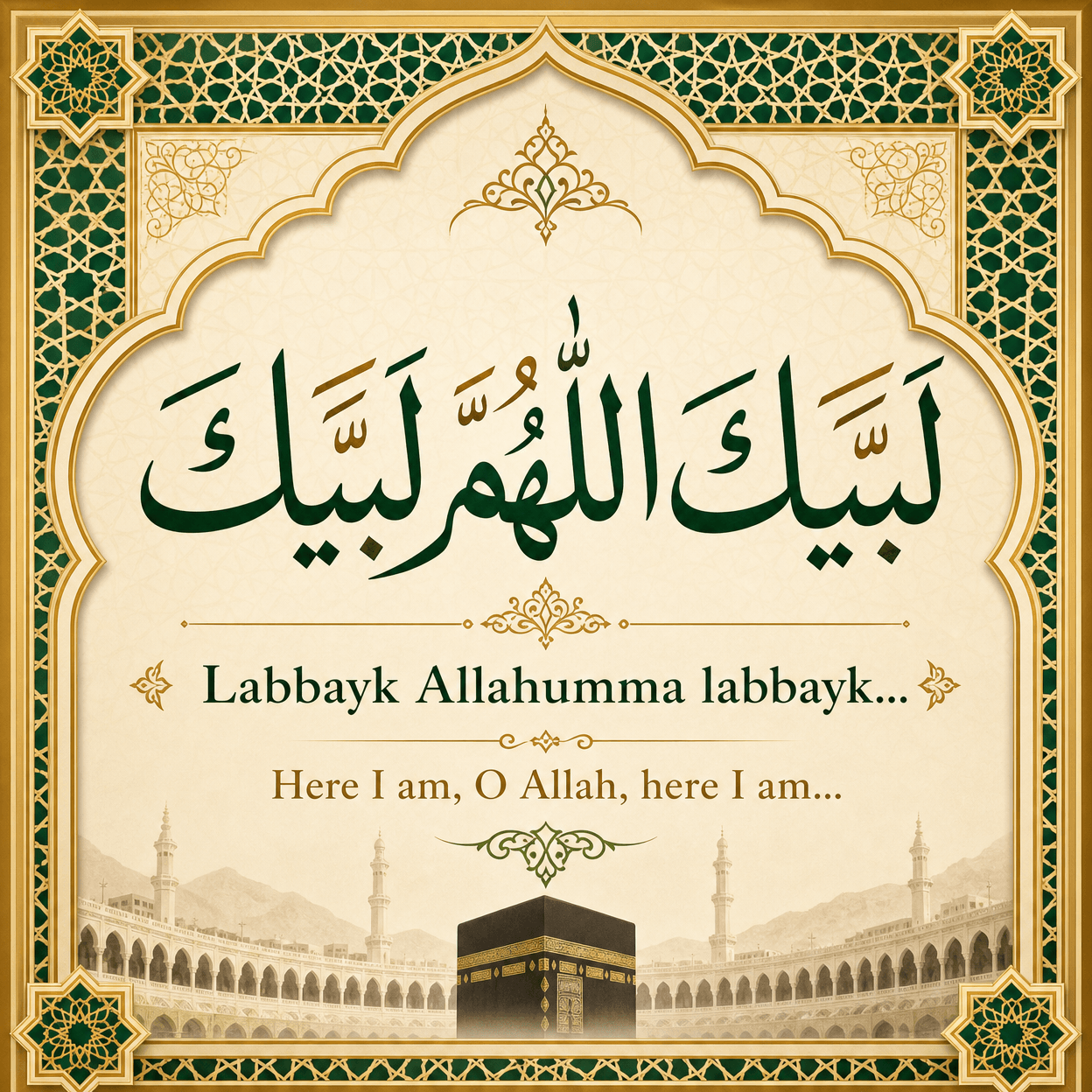
INFOGRAPHIC SUGGESTION: A calligraphy-style card with the Arabic, transliteration, and meaning of the Talbiyah. Place this at the start of the Ihram section and again in a sidebar.
Arabic:
لَبَّيْكَ اللَّهُمَّ لَبَّيْكَ، لَبَّيْكَ لَا شَرِيكَ لَكَ لَبَّيْكَ، إِنَّ الْحَمْدَ وَالنِّعْمَةَ لَكَ وَالْمُلْكُ، لَا شَرِيكَ لَكَ
Transliteration:
Labbayk Allahumma labbayk, labbayka la sharika laka labbayk, innal-hamda wan-ni‘mata laka wal-mulk, la sharika lak.
Meaning:
Here I am, O Allah, here I am. Here I am, You have no partner, here I am. Indeed, all praise, blessings, and sovereignty belong to You. You have no partner.
Recite the Talbiyah from the moment you enter ihram until you throw the pebbles at Jamarat al-Aqaba on the 10th of Dhul-Hijjah.
Day-by-Day Hajj Rituals (8th – 13th Dhul-Hijjah)
First Day – 8th Dhul-Hijjah (Day of Tarwiyah – The Day of Quenching)
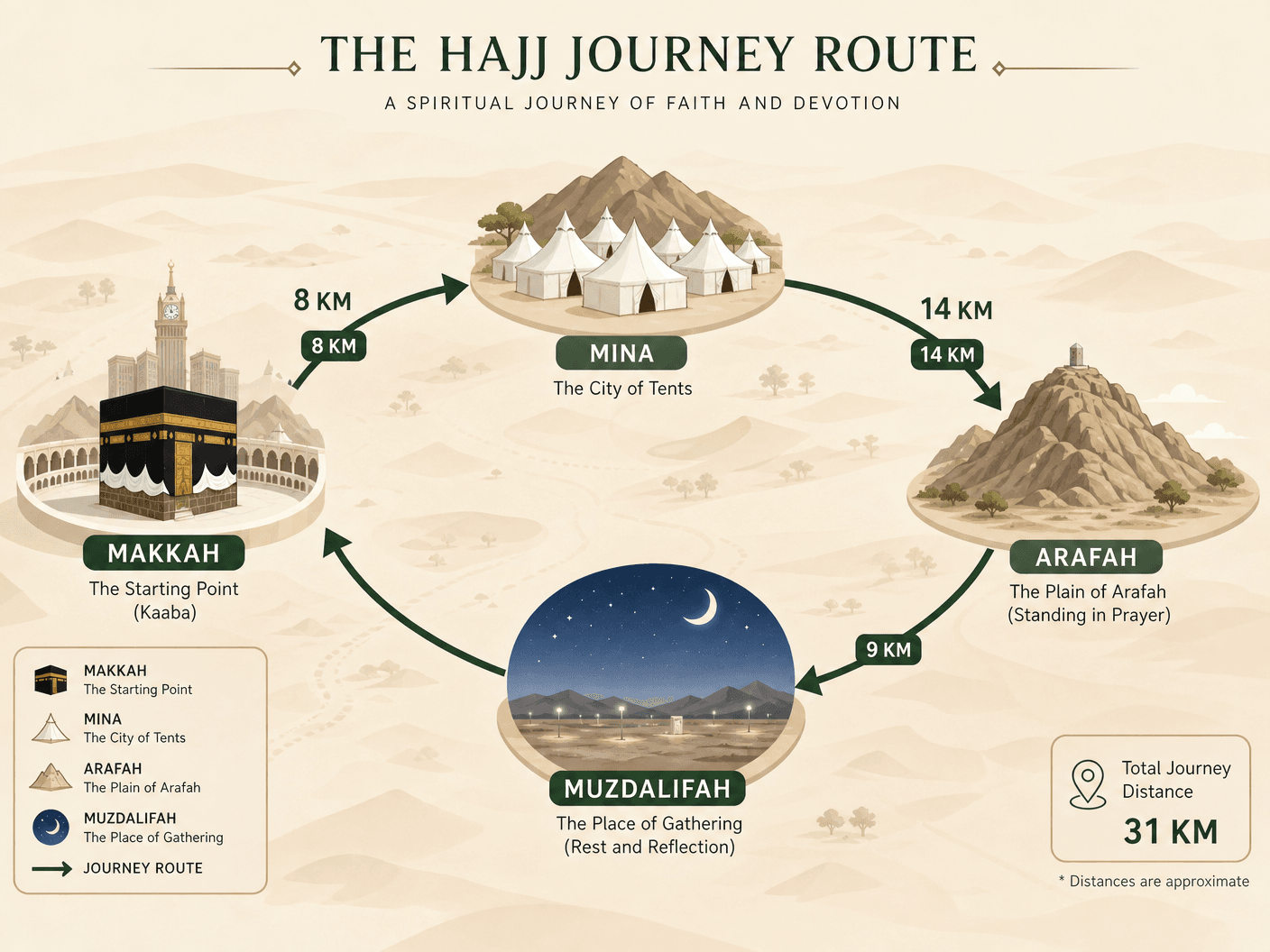
INFOGRAPHIC SUGGESTION: A map showing Makkah → Mina (tents) → Arafah → Muzdalifah → Mina again. Label distances: Makkah to Mina (~8 km), Mina to Arafah (~14 km), Arafah to Muzdalifah (~9 km). Use icons: tent, mountain, mosque, pebbles.
What you do on 8th Dhul-Hijjah:
| Time | Action | Details |
|---|---|---|
| Before sunrise | Enter Ihram for Hajj (Tamattu’ pilgrims) | Ghusl, two rak’ah, intention for Hajj, begin Talbiyah |
| After sunrise | Depart for Mina | Sunnah is to leave after sunrise, not at night |
| Throughout day | Stay in Mina | Pray Zuhr, Asr, Maghrib, Isha, and Fajr (next day) in Mina |
| Night | Spend night in Mina | Light eating (fruits/liquids recommended), abundant Talbiyah, dhikr, Quran |
💡 Pro Tip: Eat lightly in Mina. Heavy food will exhaust you during the demanding days ahead.
Second Day – 9th Dhul-Hijjah (Day of Arafah – The Heart of Hajj)
The Prophet ﷺ said: “Hajj is Arafah.” (Tirmidhi, Nasai). If you miss standing at Arafah, your entire Hajj is invalid.
Virtues of the Day of Arafah
- No day Allah frees more people from the Fire (Muslim).
- Best du’a is du’a on the day of Arafah (Tirmidhi, authenticated).
- Fasting this day (for non-pilgrims) expiates two years of sins.
Your Step-by-Step on 9th Dhul-Hijjah
| Time | Action | Spiritual Focus |
|---|---|---|
| After sunrise | Depart Mina for Arafah | Talbiyah, du’a, durood |
| Before zawal (midday) | Arrive at Arafah, complete needs | Prepare for total devotion |
| After zawal | Wuquf (standing) begins – OBLIGATORY | Face qiblah, raise hands |
| Zuhr time | Combine Zuhr & Asr (one adhan, two iqamahs) | Pray as jam’ taqdim |
| After prayers until sunset | Du’a, dhikr, istighfar – THE GOLDEN HOURS | Recite: La ilaha illa Allah wahdahu la sharika lah |
| After sunset | Depart calmly for Muzdalifah | No rushing, maintain dignity |
The Best Dhikr on the Day of Arafah
INFOGRAPHIC SUGGESTION: A large calligraphy circle with the text “لَا إِلَهَ إِلَّا اللَّهُ وَحْدَهُ لَا شَرِيكَ لَهُ، لَهُ الْمُلْكُ وَلَهُ الْحَمْدُ وَهُوَ عَلَى كُلِّ شَيْءٍ قَدِيرٌ” in the center, surrounded by smaller bubbles: “Forgiveness,” “Mercy,” “Acceptance,” “Freedom from Fire.”
Arabic:
لَا إِلَهَ إِلَّا اللَّهُ وَحْدَهُ لَا شَرِيكَ لَهُ، لَهُ الْمُلْكُ وَلَهُ الْحَمْدُ وَهُوَ عَلَى كُلِّ شَيْءٍ قَدِيرٌ
Transliteration:
La ilaha illa Allah wahdahu la sharika lah, lahul-mulk wa lahul-hamd wa huwa ‘ala kulli shay’in qadeer.
Meaning:
There is no god but Allah alone, without partner. His is the dominion and His is the praise, and He has power over all things.
Also increase in: Astaghfirullah, Salawat upon the Prophet ﷺ, and personal du’as in your own language.
Night of 9th Dhul-Hijjah – Muzdalifah (Under the Open Sky)
| Action | Details |
|---|---|
| Upon arrival | Combine Maghrib & Isha (at Isha time) |
| Night worship | Dhikr, Quran, short sleep on ground |
| Collect pebbles | 49 or 70 small pebbles (chickpea-sized) for stoning |
| After Fajr | Make du’a until sky becomes very bright (al-Mash’ar al-Haram) |
| Before sunrise | Depart for Mina |
INFOGRAPHIC SUGGESTION: A pebble counter graphic: “Day 1 (10th): 7 pebbles (Jamarat al-Aqaba only). Day 2 (11th): 21 pebbles (all 3). Day 3 (12th): 21 pebbles. Day 4 (13th, optional): 21 pebbles. Total = 49 or 70.”
Third Day – 10th Dhul-Hijjah (Day of Sacrifice & Eid al-Adha)
Four key rituals in order (flexibility allowed, but sequence is best):
1. Ramy (Stoning) of Jamarat al-Aqaba (the largest pillar)
- Target: The pillar closest to Makkah.
- Method: Throw 7 consecutive pebbles, say “Allahu Akbar” with each.
- Time: Sunrise to sunset (permissible after midnight if needed).
2. Nahr (Sacrifice)
- Commemorates Prophet Ibrahim’s willingness to sacrifice his son.
- Recommended: Include the Prophet ﷺ and his family in your intention.
3. Halq or Qasr (Shaving or Trimming)
- Men: Shave head completely (halq – more virtuous) OR trim evenly (qasr).
- Women: Do NOT shave. Gather hair and trim a fingertip’s length (approx. 1 inch) from ends.
✅ After stoning + shaving/trimming, you exit the first stage of ihram. Remove ihram clothing, wear normal clothes. Everything is permitted except marital relations. For the Quranic command regarding Hajj completion, see Surah Al-Baqarah 2:196.
4. Tawaf al-Ifadah (Obligatory Circumambulation) + Sa’i
- Fard – Hajj is invalid without it.
- Perform 7 circuits around Ka’bah, pray 2 rak’ah behind Maqam Ibrahim, drink Zamzam.
- Sa’i (Safa-Marwah) – unless already performed for Umrah (Tamattu’).
TABLE: Tawaf al-Ifadah vs. Tawaf al-Wida’
| Feature | Tawaf al-Ifadah | Tawaf al-Wida’ |
|---|---|---|
| Status | Fard (obligatory) | Wajib (necessary) |
| When | After returning from Mina (10th or later) | Just before leaving Makkah |
| Sa’i required? | Yes (unless already done for Umrah) | No |
| Exemption for menstruating women? | No – must wait until pure and perform it | Yes – can leave without it (no penalty) |
After completing Tawaf and Sa’i, return to Mina to spend the nights of 11th, 12th (and optionally 13th).
Days of Tashreeq (11th-13th Dhul-Hijjah) – Days of Drying Meat
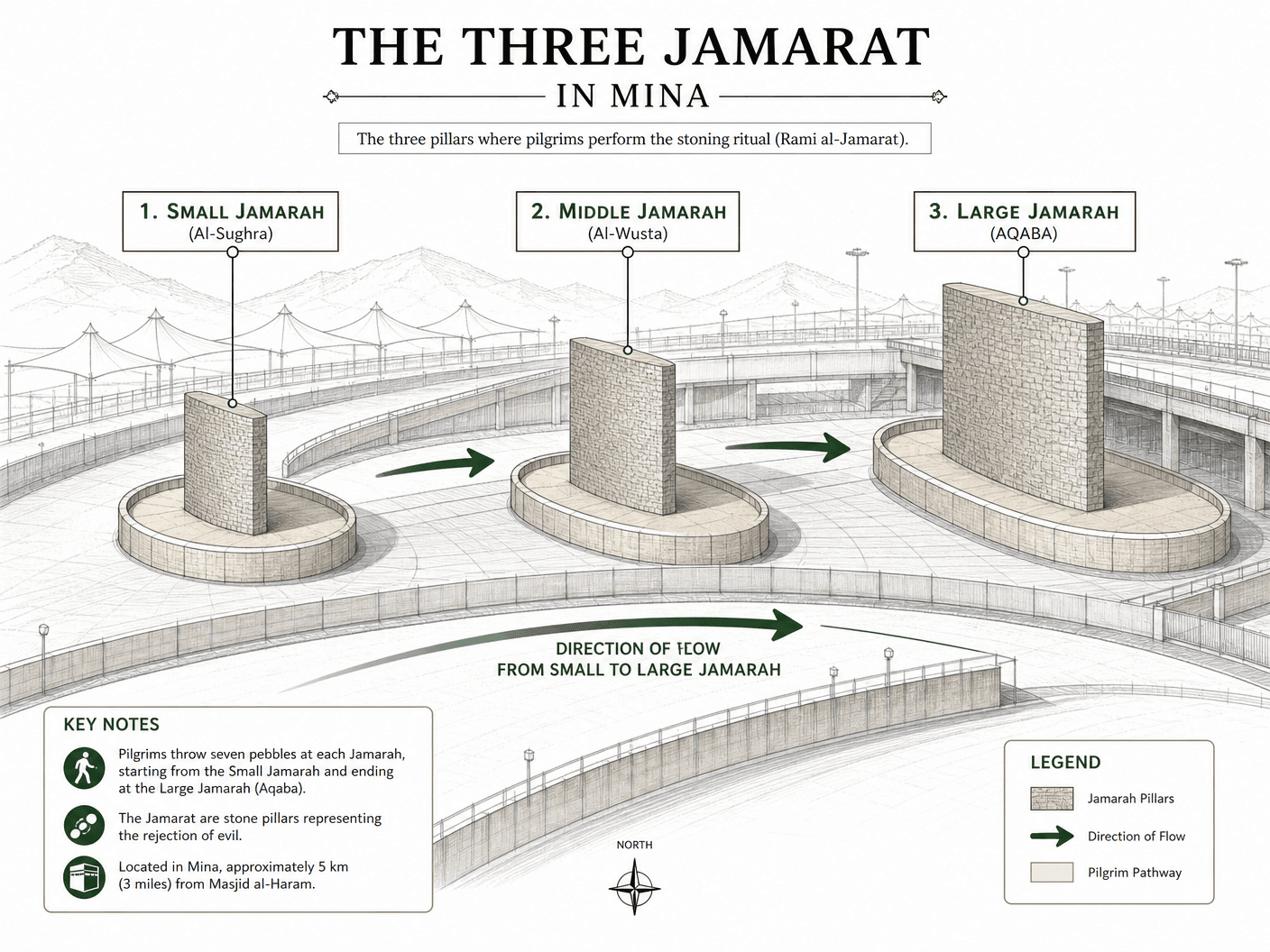
INFOGRAPHIC SUGGESTION: “The Three Jamarat – Know Your Pillars” diagram showing Mina layout: First Jamarah (small, furthest from Makkah), Second Jamarah (middle), Third Jamarah (Jamarat al-Aqaba, largest, closest to Makkah). Arrows showing direction of stoning.
What You Do on 11th & 12th Dhul-Hijjah
| Step | Action | Du’a After? |
|---|---|---|
| 1 | Stone First Jamarah (7 pebbles, “Allahu Akbar” each) | Yes – move aside, face qiblah, make lengthy du’a |
| 2 | Stone Second Jamarah (7 pebbles) | Yes – same as above |
| 3 | Stone Third Jamarah (al-Aqaba) (7 pebbles) | No – leave immediately |
When to Leave Mina – Your Choice
| Leave on 12th (after sunset) | Stay through 13th (more virtuous) |
|---|---|
| Complete Hajj after stoning | Perform stoning again on 13th |
| Must leave before sunset | Follows the Prophet’s ﷺ practice |
Allah says: “It is no sin for him who makes haste on the second day, nor sin for him who stays longer.” (Quran 2:203)
The Farewell Tawaf (Tawaf al-Wida’) – Bidding Goodbye
When you have completed all Hajj rituals and are ready to leave Makkah, perform 7 circuits around the Ka’bah with no Sa’i after.
- Status: Wajib (obligatory) for non-residents of Makkah.
- After completing: Do not linger unnecessarily. Leave promptly, heart full of gratitude, praying that Allah accept your Hajj.
- Menstruating women: Exempt. Leave without it; no penalty.
Specific Guidance for Women During Hajj (Clarity & Mercy)
Ihram & Clothing
- Wear normal modest clothing (abaya, hijab, socks) – no niqab or gloves.
- If you wish to cover face from non-mahram men, let something hang down from head covering without touching the face.
Talbiyah – Recite Softly
Women recite the Talbiyah softly to maintain modesty and avoid fitna.
Hair Trimming (NOT Shaving) – Critical Clarification
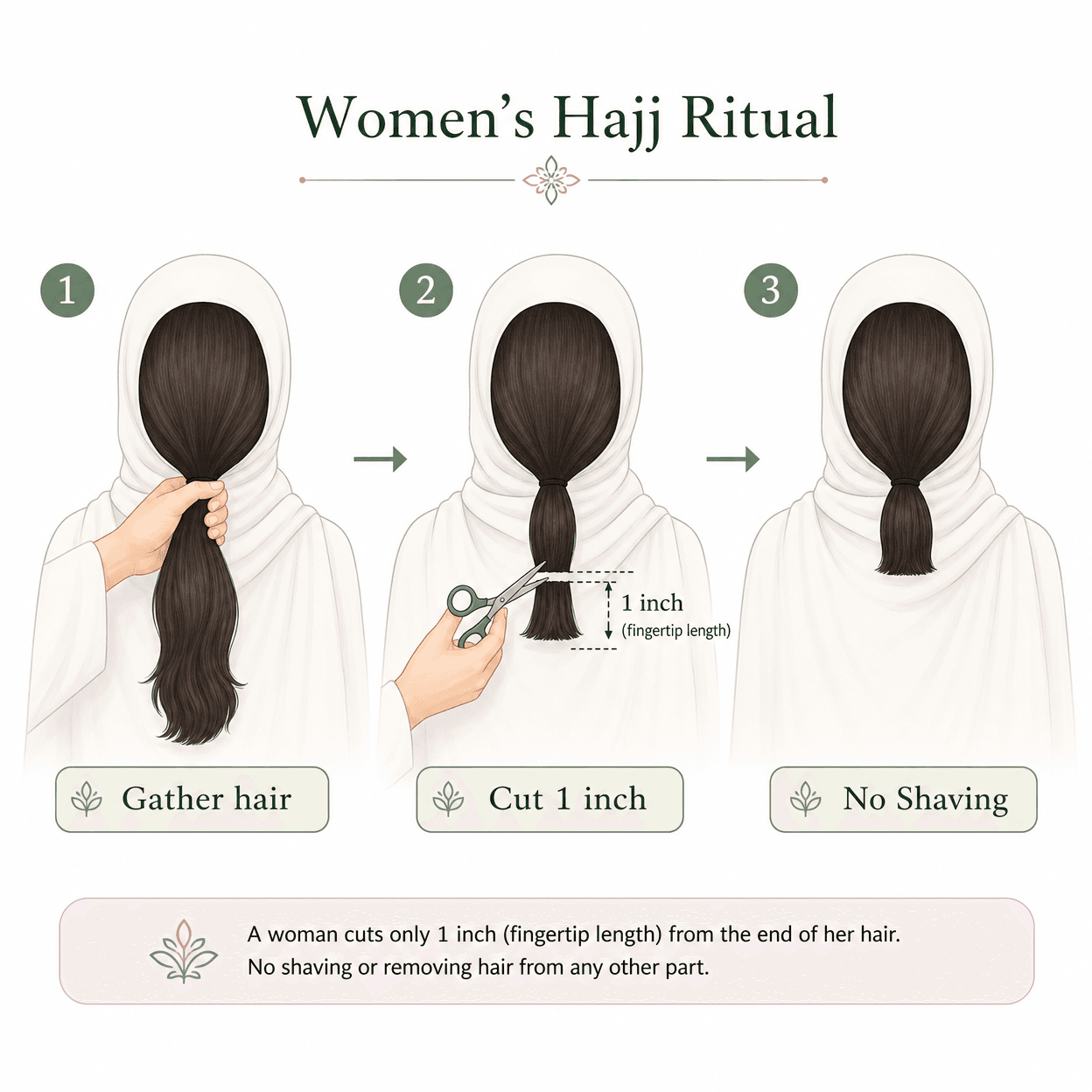
INFOGRAPHIC SUGGESTION: A simple diagram of a woman’s head with arrows showing: “Gather hair → Cut approximately one inch from ends → No shaving.”
Women do NOT shave their heads. Instead:
- Gather your hair.
- Cut a small amount – approximately the length of a fingertip (about 1 inch) from the ends of your braids or hair.
- This completes your exit from ihram, just as shaving does for men.
Menstruation (Haidh) During Hajj – Complete Rulings (No Confusion)
TABLE: What a Menstruating Woman CAN vs. CANNOT Do During Hajj
| CAN Do (Everything except prayer & tawaf) | CANNOT Do |
|---|---|
| Enter ihram (make intention & recite Talbiyah) | Any tawaf (Ifadah, Wida’, Qudum) |
| Stand at Arafah (the most important ritual) | Pray obligatory or optional prayers |
| Spend night in Muzdalifah | Touch the Quran (some schools allow with barrier) |
| Stone all three Jamarat (all days) | Enter the Masjid al-Haram (according to some rulings) |
| Stay in Mina, recite dhikr, make du’a, drink Zamzam | |
| All acts of worship except prayer/tawaf |
“Should I Make a Conditional Intention?”
No. Do not make a conditional intention (e.g., “I intend Hajj if I am not menstruating”).
The Perlis deputy mufti and Haj advisory chief explains: “Women are advised not to make a conditional intention because the Haj journey spans several days. If a woman makes a conditional intention, there is a risk her Haj may be considered invalid or incomplete.”
Make the standard intention for Hajj regardless of your state. Menstruation does not invalidate the intention.
How to Handle Tawaf al-Ifadah if Menstruating
- Tawaf al-Ifadah is fard – Hajj invalid without it.
- Wait until menses ends, perform ghusl, then perform tawaf (even if after 12th Dhul-Hijjah).
- Do not depart Makkah without this tawaf.
Tawaf al-Wida’ for Menstruating Women – Exempt
- If menses ends before departure → perform it.
- If not → leave without it. No penalty (dam).
Practical Advice Before Departure
- Trim nails and attend to personal grooming before ihram.
- Consult a physician about temporarily delaying menses (personal medical decision, not religious requirement).
Powerful Du’as for Every Stage of Hajj (With Authentic Sources)
The Prophet ﷺ made du’a at six specific places:
- Atop Safa
- Atop Marwah
- In Arafah
- In Muzdalifah
- After stoning the first Jamarah
- After stoning the second Jamarah
Du’a When Seeing the Ka’bah (Indescribable Moment)
Arabic:
اللَّهُمَّ زِدْ هَذَا الْبَيْتَ تَشْرِيفًا وَتَعْظِيمًا وَتَكْرِيمًا وَمَهَابَةً
Transliteration:
Allahumma zid hadha al-bayta tashrifan wa ta’zeeman wa takreeman wa mahaba
Meaning:
O Allah, increase this House in honor, respect, dignity, and reverence.
Then make personal du’a from your heart – this is a powerful time for acceptance.
Du’a for Arafah – The Most Important Supplication
The best du’a on the day of Arafah (as narrated by the Prophet ﷺ and previous prophets):
La ilaha illa Allah wahdahu la sharika lah, lahul-mulk wa lahul-hamd wa huwa ‘ala kulli shay’in qadeer.
Then add your personal needs: forgiveness for yourself, parents, family, the Ummah; health, guidance, protection from Fire, a good ending (husn al-khatimah). Speak to Allah in your own language.
General Powerful Du’a for Every Moment
Jami’ al-Khayr (Comprehensive Du’a):
Allahumma ighfir li wa-rhamni wa-hdini wa-‘afini wa-rzuqni
(O Allah, forgive me, have mercy on me, guide me, grant me health, and provide for me.)
Du’a for Acceptance:
Allahumma taqabbal minni (O Allah, accept from me.)
💡 Pro Tip: Don’t become overwhelmed trying to memorize every du’a. Even saying “Ya Allah” with a present heart is more powerful than long words without focus.
Quranic Verses & Hadith About Hajj (To Elevate Your Spirit)
From the Noble Quran
| Verse | Meaning |
|---|---|
| “And proclaim to the people the Hajj; they will come to you on foot and on every lean camel; they will come from every distant pass.” (Al-Hajj 22:27) | The universal call of Hajj |
| “The Hajj is during known months. So whoever has made Hajj obligatory… there is no sexual relations and no disobedience and no disputing.” (Al-Baqarah 2:197) | Sacredness of the journey |
| “Then depart from where the people depart and seek forgiveness of Allah.” (Al-Baqarah 2:199) | Standing at Arafah |
| “And remember Allah during appointed days.” (Al-Baqarah 2:203) | Days of Tashreeq |
From the Hadith
- “Hajj is Arafah.” (Tirmidhi, Nasai) – The core ritual.
- “Whoever performs Hajj for the sake of Allah and does not engage in sexual relations or commit sin will return like the day his mother gave birth to him.” (Bukhari, Muslim) – The ultimate reward.
- “The best of du’a is du’a on the day of ‘Arafah.” (Tirmidhi, authenticated by Al-Albani)
- “The pilgrim performing Hajj and the one performing ‘Umrah are the delegation of Allah. If they call upon Him, He answers them.” (Ibn Majah)
Most Common Mistakes During Hajj (And How to Avoid Them)
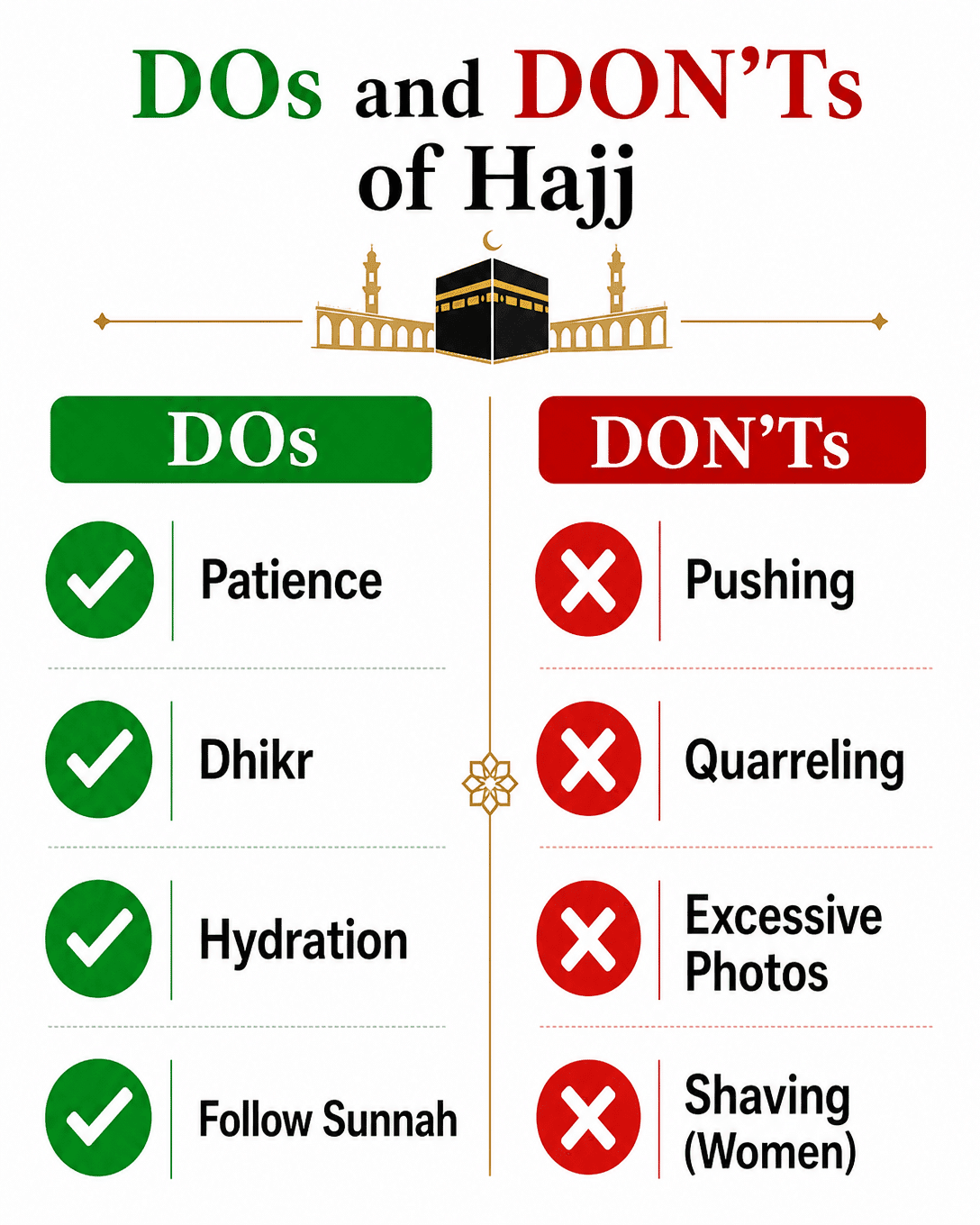
INFOGRAPHIC SUGGESTION: “DOs and DON’Ts of Hajj” – A two-column visual with green checkmarks for DOs and red X’s for DON’Ts.
| Mistake | Why It’s Wrong | Correct Action |
|---|---|---|
| Leaving for Mina at night on 8th | Contradicts Sunnah; causes hardship | Leave after sunrise |
| Leaving Arafah before sunset | Wajib to stay until sunset | Stay until sun completely disappears |
| Pushing/shoving during stoning | Harms others; not needed | Throw from wherever you are – Allah knows your intention |
| Wasting time on photography | Distracts from worship | Focus on du’a and dhikr; take minimal photos |
| Forgetting the inner dimension | Hajj becomes mechanical rituals | Renew your heart, seek forgiveness, make sincere du’a |
| Women shaving head (instead of trimming) | Incorrect and harmful | Trim a fingertip’s length (approx. 1 inch) |
Practical Tips for a Smooth & Accepted Hajj
- Travel light – A sheet, sleeping bag, one change of clothes, soap, tissue, towel.
- Stay hydrated – May/June heat is extreme. Drink water constantly.
- Wear comfortable footwear – Durable sandals for many kilometers.
- Carry identification – Group name, tent number, emergency contacts.
- Stay with your group – Especially in Arafah (tents look identical).
- Pace yourself – Rest when you can. Hajj is physically demanding.
- Avoid quarrels – The Quran says no disputing during Hajj. Be patient.
After Hajj – Returning as a Newborn Soul
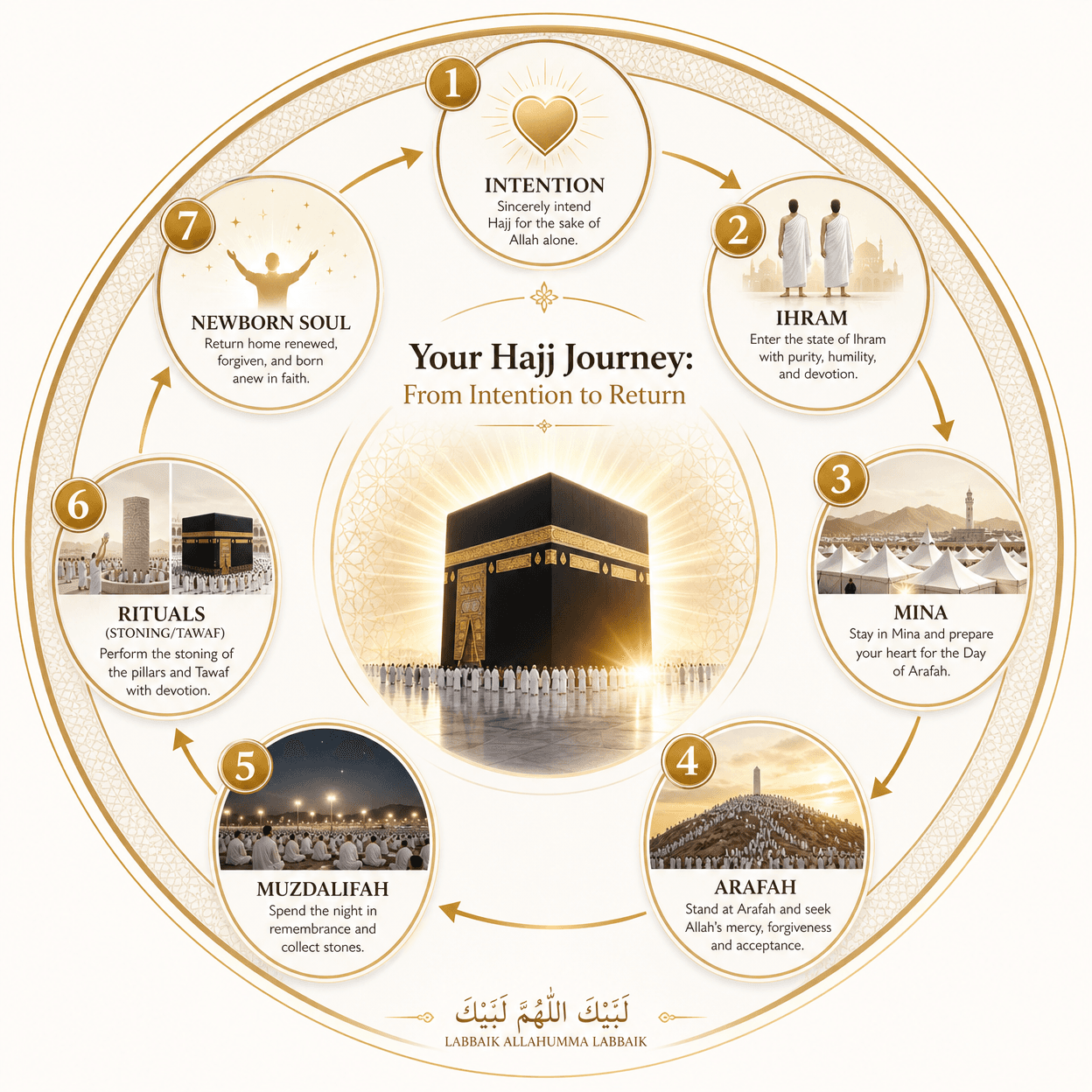
The Prophet ﷺ said: “Whoever performs Hajj for the sake of Allah and does not engage in sexual relations or commit sin will return like the day his mother gave birth to him.” (Bukhari, Muslim)
Signs of an accepted Hajj (Hajj Mabroor):
- You leave with humility and gratitude.
- Your desire for sin diminishes.
- You are more conscious of Allah in daily life.
- You are kinder to family and community.
- Your wealth is spent in halal ways afterward.
Frequently Asked Questions (FAQs) About Hajj 2026
1. Can I perform Hajj on behalf of someone else?
Yes, if you have already performed Hajj for yourself. The Prophet ﷺ allowed a man to perform Hajj for his elderly father. You must make the intention on their behalf.
2. What if I miss standing at Arafah completely?
Your Hajj is invalid. You must either repeat Hajj in a future year or, if unable, offer a sacrifice (dam) and make sincere tawbah. Hajj is Arafah.
3. Can a woman travel for Hajj without a mahram (male guardian)?
Under normal circumstances, a mahram is required. However, many scholars permit women over 45 to travel in a trustworthy group for Hajj due to modern safety measures. Check your country’s Hajj regulations.
4. What is the penalty (dam) for violating ihram prohibitions?
It depends: wearing sewn clothes (men) → sacrifice a sheep; covering head (men) or applying perfume → feed six poor people or fast three days; marital relations before first exit from ihram → Hajj invalid.
5. Can I use scented soap or deodorant in ihram?
No. Use unscented, fragrance-free products. Perfume is strictly prohibited while in ihram.
6. What if I accidentally kill an insect or hunt while in ihram?
Hunting is forbidden. If intentional, a penalty is required. If accidental and minor (like a mosquito), seek forgiveness – no penalty for unintentional acts without negligence.
7. Do I need to perform Sa’i again if I already did it for Umrah (Tamattu’)?
No. In Hajj Tamattu’, you perform Sa’i only once – after your Umrah. You do not repeat it after Tawaf al-Ifadah unless you wish to do so voluntarily.
8. Can I use a wheelchair if I am physically weak?
Absolutely. There is no sin. Use available accommodations – Allah desires ease, not hardship. Many elderly pilgrims use wheelchairs for tawaf and sa’i.
9. What is the ruling on taking medication during ihram?
Permitted. Health comes first. You may take any necessary medication, including injections, pills, or even undergoing surgery. It does not invalidate ihram.
10. How do I know my Hajj is accepted (Hajj Mabroor)?
Genuine signs include: positive change in your character, reduced sinning, increased gratitude, kindness to others, and a feeling of humility. But ultimately, acceptance is with Allah alone. Continue making du’a: Allahumma taqabbal minni.
11. What if I am unable to complete all stoning days due to illness?
If you are genuinely unable, you may authorize someone else (a trusted pilgrim) to stone on your behalf. They should stone for themselves first, then for you.
12. Can I perform Umrah after Hajj before leaving Makkah?
Yes. After completing Hajj and the Farewell Tawaf, you may exit Makkah to a nearby area (like Masjid Aisha in Taneem), enter ihram for Umrah, and perform it. This is called “Umrah after Hajj.”
May Allah accept your Hajj, forgive your sins, and return you to your family as a newborn soul. Ameen.
Final Note: Bookmark this guide. Share it with fellow pilgrims. And most importantly – take it with you in your heart, not just your bag.